

One of the most frequent questions we receive at Recover.ae about infrared saunas is: "What are the EMF readings?"
It's a fair question — and one worth answering properly.
As awareness around electromagnetic fields (EMFs) has grown across the UAE and globally, more people are paying attention to the technology environments they spend time in. That's a reasonable instinct when investing in wellness products for the home.
But what's often missing from the conversation is context.
Many people become highly concerned about EMF exposure during a 20–30 minute sauna session, while spending the rest of their day surrounded by devices that frequently produce significantly higher readings at much closer range.
🔍 Quick Answer
Infrared saunas produce measurable EMFs because they use electricity — just like your phone, smartwatch, Wi-Fi router, and laptop. A properly designed sauna with low-EMF carbon heaters, used for 20–30 minutes a few times per week, represents a relatively small proportion of most people's total daily EMF exposure. Context and quality engineering matter more than marketing claims.
What Are EMFs and Where Do They Come From?
Electromagnetic fields (EMFs) are areas of energy produced wherever electricity flows or wireless signals are transmitted. They exist on a spectrum — from extremely low frequency (ELF) fields produced by power lines and appliances, to radiofrequency (RF) fields produced by wireless devices.
Common everyday sources of EMF exposure include:
- Mobile phones — especially when held to the ear or kept in a pocket
- Smartwatches worn directly on the wrist 24 hours a day
- Smart rings worn continuously on the finger
- Wi-Fi routers — often positioned beside desks or on bedside tables
- Bluetooth wireless earbuds worn close to the head
- Laptops used on the lap
- Hair dryers used close to the scalp
- Microwave ovens
- Electric vehicles with extensive onboard electronics
- Smart home systems and connected appliances
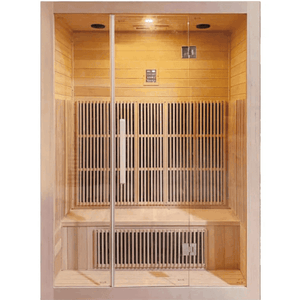
- Infrared sauna heaters
EMFs are not unique to saunas. They are a standard part of modern living — and the conversation around them is most useful when grounded in realistic data rather than fear-based marketing.
Why Infrared Saunas Get So Much Attention?
Infrared saunas use electrically powered heating panels, which naturally generate measurable EMFs. As a result, the sauna industry has become heavily focused on marketing language such as:
- "Ultra-low EMF"
- "Near-zero EMF"
- "Zero EMF certified"
While responsible low-EMF design is genuinely worthwhile and something Recover.ae prioritises, parts of the wellness industry have amplified fear around sauna EMFs without providing honest comparison to everyday exposure levels.
The result: customers sometimes become anxious about a 25-minute sauna session while wearing a smartwatch, sitting next to a Wi-Fi router, and carrying their phone in their pocket.
Putting EMF in Perspective: A Practical Comparison
A handheld EMF meter is one of the most effective tools for understanding real-world exposure. Many people who test their home environment are surprised by what they find.
|
Device / Source |
Proximity to Body |
Usage Pattern |
Context |
|
Mobile phone (active call) |
Directly against ear/head |
Multiple times daily |
High close-range exposure |
|
Smartwatch |
Wrist — continuous skin contact |
24 hours/day, 7 days/week |
Constant low-level exposure |
|
Smart ring |
Finger — direct skin contact |
24 hours/day, 7 days/week |
Constant close-range exposure |
|
Wi-Fi router |
Desk or bedside — 30–100cm |
Continuous |
All-day, all-night exposure |
|
Laptop |
On the lap |
Hours per day |
Sustained close-range exposure |
|
Wireless earbuds |
Inside ear canal |
1–4 hours daily for many users |
Very close proximity |
|
Infrared sauna heater |
Several inches from body |
20–30 mins, 3–5x per week |
Limited sessions, moderate distance |
Distance from an EMF source matters enormously. EMF intensity follows an inverse square law — doubling your distance from a source reduces exposure to one quarter. A heater panel several inches from the body behaves very differently from a device worn directly on the skin.
Modern Life Is Increasingly Connected — And That's the Real Context
Today, the average person in Dubai and across the UAE:
- Sleeps with their phone beside or under their pillow
- Wears a smartwatch or fitness tracker around the clock
- Spends 6–10 hours per day working on a laptop or computer
- Sits within 1–2 metres of a Wi-Fi router for most of the day
- Uses wireless earbuds or headphones for calls and music
- Lives in a smart home with connected lighting, appliances, and security systems
- Drives vehicles loaded with onboard electronics and wireless systems
This is not alarmist — it's simply the reality of a modern connected lifestyle. In this context, a 25-minute infrared sauna session with properly designed low-EMF carbon heaters represents a genuinely small fraction of overall daily EMF exposure for most people.
EMF Readings: Why Testing Methods Matter?
EMF measurements are not as simple as a single definitive number. Readings can vary significantly depending on:
- The type and calibration of the meter used (ELF vs RF measurement)
- Distance from the heating element at the time of testing
- Whether the heater is actively cycling or at rest
- Room wiring conditions and grounding quality
- Which area of the sauna interior is being measured?
- Whether the measurement is in mG (milligauss), V/m, or μW/cm²
This is why isolated online comparison videos or single-reading tests can be misleading without methodological context. A quality sauna manufacturer should prioritise safe electrical design and proper grounding — not simply chase impressive-sounding marketing figures.
⚡ Key Principle
A low EMF reading achieved by compromising heater output, insulation quality, or electrical safety is not a better sauna. EMF management should be part of responsible overall engineering — not a marketing shortcut.
Low EMF Marketing Does Not Automatically Mean Higher Quality
Some lower-cost sauna products heavily promote "ultra-low EMF" or "zero EMF" credentials while cutting corners in other critical areas:
- Heater performance and heat output consistency
- Wood quality and structural durability
- Insulation and heat retention
- Electrical component quality and safety certifications
- Long-term reliability in high-heat environments like the UAE
The best infrared sauna is one that balances all of these factors — with responsible EMF management as one component of a complete, well-engineered product. Not a device that achieves a headline EMF figure at the expense of everything else.
The Primary Purpose of a Sauna Is Heat Therapy
Sometimes the EMF conversation becomes so dominant that the actual reason to use a sauna gets lost. The clinically documented benefits of regular infrared sauna use include:
- Cardiovascular conditioning and circulation improvement
- Muscle recovery and reduction of delayed onset muscle soreness (DOMS)
- Stress hormone regulation and nervous system recovery
- Sleep quality improvement
- Immune system support
- Skin health through increased circulation and sweating
- Mobility and joint flexibility
- Mental wellbeing through parasympathetic nervous system activation
Focusing exclusively on isolated EMF numbers while overlooking poor sleep, chronic stress, sedentary behaviour, excessive screen time, and irregular recovery habits creates an unbalanced approach to health — one that optimises a minor variable while ignoring major ones.
Fear-Based Wellness Marketing: A Growing Problem
Modern wellness marketing increasingly relies on fear to sell products. Consumers are routinely told to be concerned about:
- EMFs from saunas and devices
- Wi-Fi signals
- Plastics in food containers
- Toxins in everyday products
- Blue light from screens
- Ingredients in processed foods
Education and awareness are genuinely valuable. But excessive fear-based marketing can create unnecessary anxiety about ordinary life — and sometimes leads people to spend more on "protective" products than the risk warrants.
At Recover.ae, our approach is different:
- Design products responsibly with appropriate safety standards
- Reduce unnecessary EMF exposure through quality engineering where it makes a practical difference
- Be honest about real-world exposure context
- Focus customer attention on the wellness habits that have the greatest impact
- Avoid exaggerated claims or fear-based messaging
Traditional Saunas Also Use Electricity
It is worth noting that infrared saunas are not uniquely electrical. Traditional Finnish-style saunas also rely on:
- Electric heating elements (in most home installations)
- Digital control panels and timers
- Internal lighting
- Ventilation systems
The relevant conversation is therefore about quality of electrical engineering, proper grounding, installation standards, and overall product design — not about saunas as an inherently problematic category.
The UAE Context: Surrounded by Connectivity
In the UAE specifically, the connected lifestyle is more pronounced than in many other regions:
- High smartphone penetration and usage rates
- Widespread smart home adoption in Dubai and Abu Dhabi
- High-density wireless network coverage
- Modern vehicles with extensive onboard electronics
- Air-conditioned indoor environments with dense electrical systems
For most UAE residents, the more impactful wellness priorities are:
- Consistent sleep quality and timing
- Effective recovery from heat, stress, and physical training
- Stress management and nervous system regulation
- Building regular movement and recovery habits
These are precisely the areas where regular sauna use — in a properly designed, quality product — can make a meaningful and measurable difference.
How Recover.ae Approaches Sauna Design?
Our infrared saunas are engineered with:
- Low-EMF carbon fibre heating panels — more even heat distribution with responsible EMF output
- Professional electrical integration and grounding systems
- Quality wiring and component standards suitable for the UAE climate
- Installation guidance that meets local safety requirements
- Honest performance specifications without inflated marketing claims
The goal is a sauna that is safe, reliable, comfortable, and effective for long-term wellness use — built for the real conditions of Dubai and Abu Dhabi, not optimised for a headline specification number.
Related Reading
Explore the full benefits of infrared sauna use: What Are the Real Benefits of an Infrared Sauna — and Are They Worth It?
Infrared vs traditional sauna — which is right for you? What Is the Difference Between Traditional Saunas and Infrared Saunas?
How much does an infrared sauna cost to run in the UAE? How Much Electricity Does an Infrared Sauna Use in the UAE?
Planning an installation? Read this first: What to Expect During Your Infrared Sauna Installation with Recover
Combining sauna with cold therapy: What Is Contrast Therapy and How Does It Work?
How saunas are built for the UAE climate: Building Saunas for Extreme Conditions — How Recover Creates Saunas for the UAE









Leave a comment
This site is protected by hCaptcha and the hCaptcha Privacy Policy and Terms of Service apply.