

Quick Answer
ACL surgery recovery at home is rarely just about healing the knee. It involves managing swelling through the RICE method (rest, ice, compression, elevation), navigating long hours of restricted movement, and coping with the mental ups and downs of a slow, non-linear rehabilitation timeline. Comfort tools that combine cold therapy and compression, like the Recover ColdFlow Recovery System, can reduce the daily friction of post-surgery recovery and support consistency with physiotherapy.
When people talk about surgery, they usually focus on the operation.
The date.
The surgeon.
The procedure.
Whether it was successful.
What almost nobody talks about is what happens when you get home — the part of ACL surgery recovery that unfolds quietly, day after day, long after the anaesthesia has worn off.
Over the past few weeks, we've experienced this first-hand as our own family has supported a teenager through ACL reconstruction surgery. While every recovery is different, one thing became obvious almost immediately.
The operation was only the beginning. Everything that happens afterwards — the swelling, the stiffness, the emotional swings — is what truly defines post-surgery recovery at home.

Your World Suddenly Gets Smaller
One day you're walking, driving, working, exercising and living life without thinking.
The next, you're planning every movement.
Standing up requires effort.
Getting downstairs needs assistance.
A trip to the bathroom becomes an expedition.
Even carrying a drink across the room is suddenly impossible.
The loss of independence is something few people expect.
It's not dramatic.
It's simply relentless.
This sudden shrinking of daily life is one of the most under-discussed parts of knee surgery rehabilitation, whether the procedure was ACL reconstruction, a meniscus repair, or a full knee replacement.
You Spend More Time Sitting Than You Ever Thought Possible
Recovery sounds restful until you actually have to do it.
Hours become days spent sitting with your leg elevated.
The swelling comes down a little.
You move.
The swelling comes back.
So you elevate it again.
Ice.
Compression.
Elevation.
Repeat.
Eventually, something unexpected starts to happen.
Your back begins to ache.
Your hips become stiff.
Your muscles tighten.
You develop what can only be described as a permanently numb backside from sitting in the same position for so many hours.
It's uncomfortable.
It's frustrating.
And nobody really warns you about it.
This cycle is essentially the RICE method — rest, ice, compression, elevation — playing out in real time. It's the foundation of swelling management after surgery, and it's also exactly why the right cold therapy and compression therapy tools matter so much during this stage of recovery.
The Mental Battle Can Be Harder Than the Physical One
People often assume recovery is simply about healing tissues.
In reality, there's another battle happening at the same time.
You begin questioning your progress.
“Why is it still swollen?”
“Shouldn't I be bending it further by now?”
“Will I ever walk normally again?”
Then you see everyone else getting on with life while yours feels like it's standing still.
The days become repetitive.
Ice.
Exercises.
Medication.
Elevation.
Sleep.
Repeat.
Motivation naturally comes and goes.
Some days you feel like you're making huge progress.
The next morning it feels like you've gone backwards.
That emotional rollercoaster is completely normal, but it's rarely spoken about.
This mental side of recovery is a normal part of any orthopaedic recovery timeline, and recognising it as normal — rather than a sign of failure — is often the first step to getting through it.
Every Small Improvement Matters
During recovery, you quickly realise something.
It's rarely one big breakthrough that makes life easier.
It's dozens of small improvements.
Sleeping a little better.
Standing for a little longer.
Walking a few more steps.
Needing a little less pain relief.
Finding a more comfortable position.
Reducing swelling just enough to complete your physiotherapy exercises.
Each one gives you another small win.
Those wins keep you moving forward.
We Learned That Comfort Isn't a Luxury
Before experiencing surgery in our own family, we probably underestimated how important comfort is during rehabilitation.
Now we see it differently.
If something helps control swelling more effectively...
If it saves another trip to the freezer...
If it allows someone to relax while receiving cold therapy...
If it makes physiotherapy a little easier the following morning...
Those aren't luxuries.
They're meaningful improvements during what can be one of the most physically and mentally demanding periods a person experiences.
Recovery Is a Marathon, Not a Sprint
Recovery isn't measured in days.
It's measured in consistency.
The exercises you complete when you don't feel like doing them.
The swelling you manage before it gets out of control.
The patience you show when progress feels painfully slow.
The support you receive from family and friends.
The routines you stick to every single day.
These are the things that gradually build a successful recovery.
Why We Developed the Recover ColdFlow Recovery System?
Experiencing surgery so closely changed how we viewed recovery products.
We realised they shouldn't simply be pieces of equipment.
They should remove friction from the recovery process.
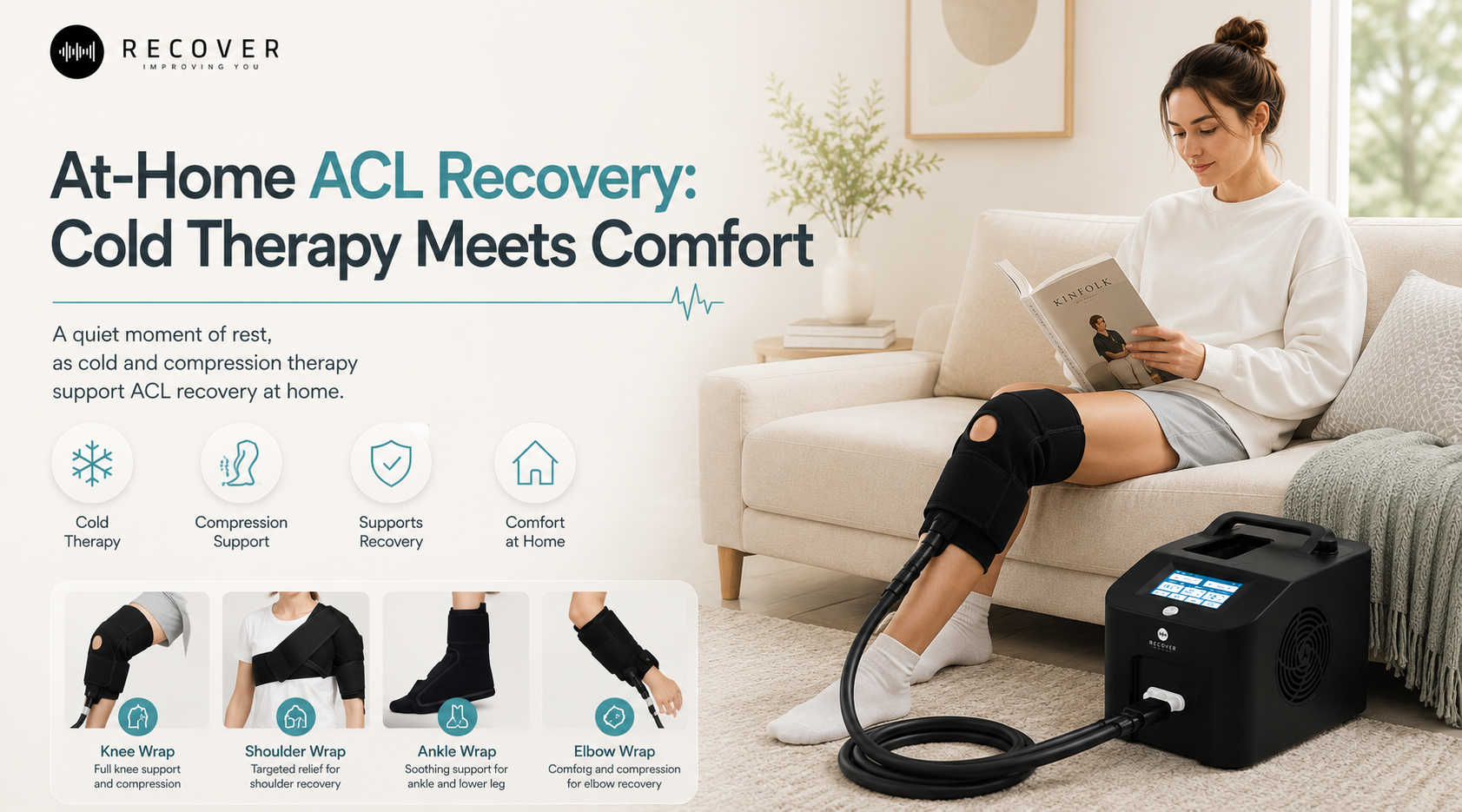
The Recover ColdFlow Recovery System was created with exactly that goal.
By combining temperature-controlled therapy with adjustable compression in one portable unit, it helps simplify one of the most repetitive parts of rehabilitation. Less time preparing ice packs means more time resting, recovering, or focusing on the exercises that matter.
It won't remove the hard work.
Nothing can.
Recovery still requires commitment, patience, and guidance from your surgeon and physiotherapist.
But if it can make one difficult day a little easier...
Help reduce swelling after a tough physiotherapy session...
Or simply make someone more comfortable during those long hours spent recovering...
Then it's doing exactly what it was designed to do.
For a closer look at how targeted compression fits alongside cold therapy, see our guide to leg compression massage devices, and how contrast therapy can be layered into a rehabilitation routine once your physiotherapist gives the go-ahead.
If You're Recovering Right Now
Whether you've had ACL reconstruction, shoulder surgery, ankle ligament repair, a knee replacement, or another orthopaedic procedure, know this:
If you're frustrated, you're not failing.
If you're tired of sitting still, that's understandable.
If recovery feels mentally draining as well as physically demanding, you're far from alone.
Healing isn't always a straight line.
Some days will feel like huge steps forward.
Others will feel like you've made no progress at all.
Keep showing up.
Keep following your rehabilitation plan.
Celebrate the small victories.
One day you'll look back and realise that all those ordinary, repetitive days were quietly rebuilding your strength.
If pain in the hip, knee, or back is part of your recovery, our guide on managing acute pain in the body with cold plunges explains how cold therapy can support relief once you're cleared for it. And for the science behind why cold therapy is so widely used in rehabilitation, take a look at the top 7 benefits of ice baths and why athletes swear by ice baths after workouts.
Frequently Asked Questions
How long does ACL surgery recovery take at home?
Most people spend the first one to two weeks focused on swelling management, rest, and early range-of-motion exercises, with fuller rehabilitation continuing for several months under a physiotherapist's guidance. The early at-home phase, covered in this article, is often the most physically and mentally demanding part of the whole timeline.
What is the RICE method and why does it matter after knee surgery?
RICE stands for Rest, Ice, Compression, and Elevation. It's the standard approach to controlling post-surgical swelling and is typically repeated multiple times a day in the early recovery period, which is why comfortable, easy-to-use tools make such a practical difference.
Why does swelling keep coming back after surgery?
Swelling naturally returns with movement, activity, or extended time off ice, especially in the early weeks. This is a normal part of the healing process rather than a sign that something is wrong, though it should always be monitored alongside your surgeon's advice.
Is it normal to feel emotionally low during recovery?
Yes. The emotional ups and downs of recovery — frustration, impatience, comparing your progress to others — are extremely common and a normal part of any rehabilitation journey, not a sign of failure.
How can the Recover ColdFlow Recovery System help during recovery?
It combines temperature-controlled cold therapy with adjustable compression in one portable unit, reducing the time and effort spent preparing ice packs so more energy can go toward rest and physiotherapy.
Ready to Make Recovery a Little Easier?
Discover how the Recover ColdFlow Recovery System can support your rehabilitation journey with combined cold and compression therapy. Explore the Recover ColdFlow Recovery System







Leave a comment
This site is protected by hCaptcha and the hCaptcha Privacy Policy and Terms of Service apply.